Sizes, artwork & formats
Label Size Guide for Jars, Bottles, Pouches and Boxes
The right size is the largest label that still lies flat. Measure the pack, not the product weight, because a 250 g jar can be three different shapes.
By staynish, Prayagraj ·
The short answer
Measure the flat or straight-sided part of the pack and take 2 to 3 mm off each side. For a full wrap, the width is the circumference plus an overlap of about 5 to 10 mm. For a front label on a round pack, stay under about 40% of the circumference. Test with paper before ordering.
How to measure each pack
| Pack | Measure | Then |
|---|---|---|
| Round jar or bottle | Straight wall height, and circumference with a paper strip | Height minus 4–6 mm; wrap = circumference + overlap |
| Square or hexagonal jar | Width of one flat face | Face width minus 4–6 mm |
| Tapered cup or tub | Circumference at top and bottom | Use a small front label, or ask for a curved shape |
| Stand-up pouch | Flat front when filled | Stay clear of the seals, zip and gusset |
| Box or carton | The face, or the lid join for a seal | Leave a margin, or bridge the join |
| Tube | Flat area when full | Keep off the crimp and shoulder; use a flexible film |
| Dropper or vial | Diameter and straight height | Small wrap or front and back labels |
The wrap-around formula
Circumference = diameter × 3.14. A bottle 65 mm across measures about 204 mm round, so a full wrap is about 210 to 214 mm wide with the overlap. Wrapping a paper strip and marking where it meets is more accurate than measuring the diameter.
Starting sizes to test
These are starting points for a paper mock-up, not standards. Packs of the same weight differ a lot.
| Pack | A size to mock up first |
|---|---|
| 100–250 g jar, front label | 2 × 3 in to 3 × 3 in (51 × 76 to 76 × 76 mm) |
| 500 g jar, front label | 3 × 3 in to 4 × 3 in (76 × 76 to 102 × 76 mm) |
| Jar lid | 2 in circle (51 mm) |
| Sweet or bakery box seal | 2 in circle (51 mm) |
| 500 ml water bottle wrap | 8 × 2 in (203 × 51 mm), checked against your bottle |
| 100–250 g pouch | 3 × 2 in to 4 × 3 in (76 × 51 to 102 × 76 mm) |
| 30 ml dropper | 2 × 1 in (51 × 25 mm) |
| 1 litre oil bottle, front | 4 × 6 in (102 × 152 mm), if the panel allows |
Make a paper mock-up
- Print the design at 100%, not "fit to page"
- Cut it out and tape it on a filled pack
- Look from a metre away: can you read the name?
- Check the corners lie flat
- Check the smallest text with your own eyes, not zoomed in
Why labels crease or lift
- The label covers a shoulder, rib or base curve
- It wraps a surface that curves in two directions
- It runs over a pouch seal or a carton score
- The corners are square on a small diameter
Orientation matters
Printers read size as width × height, with the text upright. A 2 × 6 in label is tall; a 6 × 2 in label is wide. Say which way the text runs when you order.
Sizes you can order online
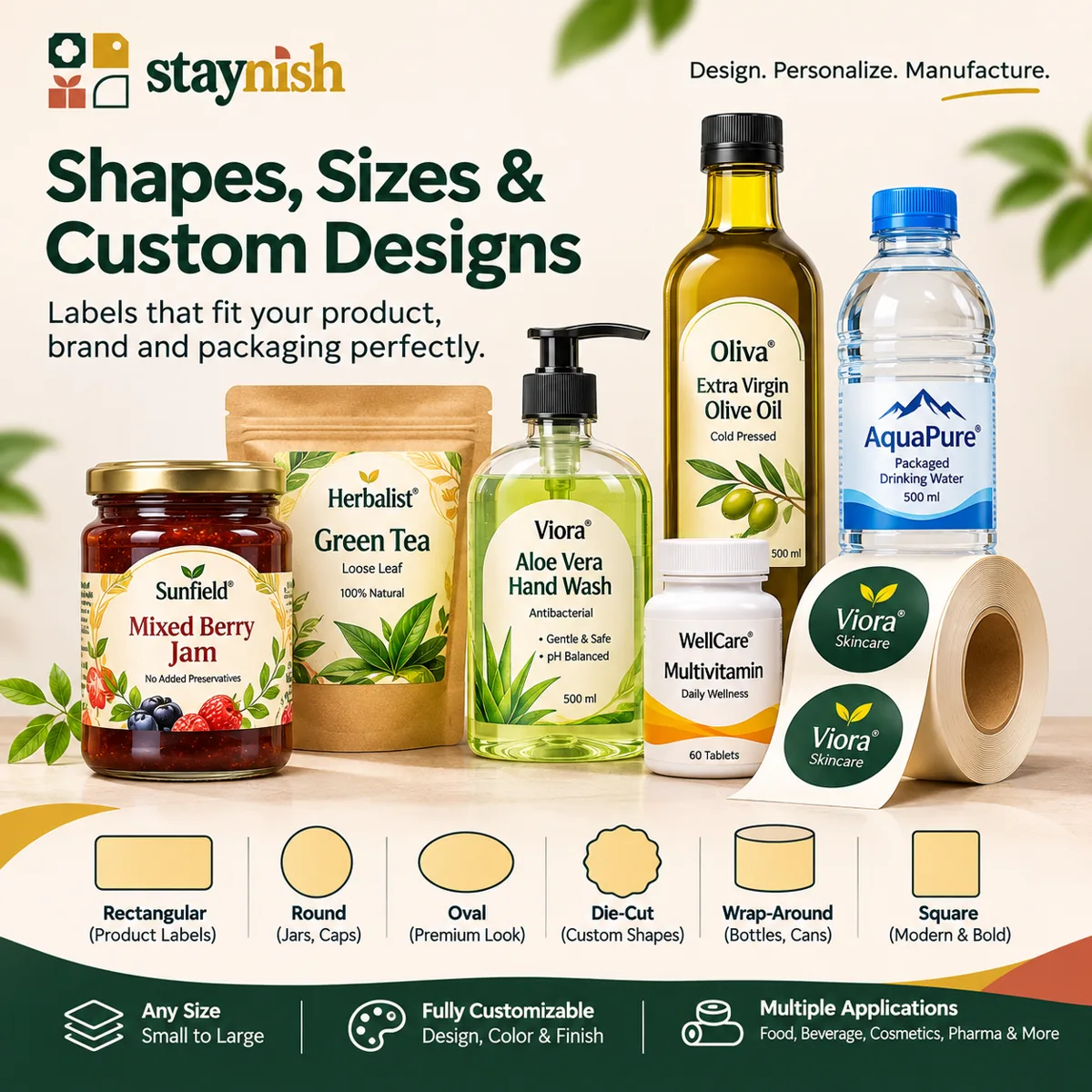
StayNish sells square, circle, rectangle, rounded-corner, oval and custom-shape labels from 2 × 1 in up to 4 × 12 in with instant prices. Anything else is made by quote.
Frequently asked questions
What size label fits a 500 ml water bottle?
Many take a wrap around 200 to 215 mm wide and 45 to 55 mm tall, but bottles vary. Measure yours with a paper strip.
How do I measure a round jar for a label?
Wrap a strip of paper round the straight part, mark the meeting point and measure it flat. Measure the straight height separately.
How much smaller than the surface should a label be?
About 2 to 3 mm on each side, more near a curve or edge.
Can I order a size in millimetres?
Yes, by quote. Online sizes are in inches with the closest millimetres shown.
Ready to order your labels?
Choose your shape, size, material and quantity, upload your artwork and check out.